All about product
 Reviews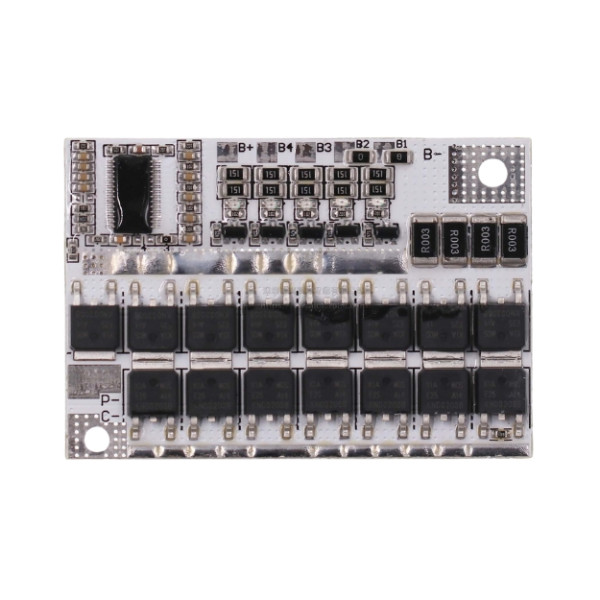
-600x600.jpg "BMS, charge controller 5s 100A 21V TNDC li-ion")
-600x600.jpg "BMS, charge controller 5s 100A 21V TNDC li-ion")
-600x600.jpg "BMS, charge controller 5s 100A 21V TNDC li-ion")
-600x600.jpg "BMS, charge controller 5s 100A 21V TNDC li-ion")
-600x600.jpg "BMS, charge controller 5s 100A 21V TNDC li-ion")

BMS (Battery Management System) is an electronic board or module that is installed for unprotected batteries (or for battery assemblies) to control charge/discharge and monitor the battery status:
temperature control
number of charge/discharge cycles
protection of battery components
The BMS protection board or module provides individual control over the voltage and resistance of each battery, and also evenly distributes the charge current between each cell in the battery assembly during charging, monitors the charge current, measures the loss of capacity of each battery, and guarantees safe connection and disconnection of the load.
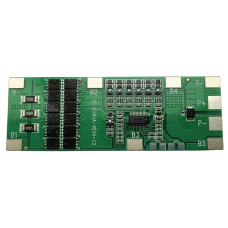
BMS boards differ from each other in size, parameters, and the number of batteries connected. The principle of protection in BMS modules is to monitor the voltage on each battery and if any element exceeds the threshold, the BMS will disconnect such a battery from charging or from the load, thus preserving its properties. These BMS boards can also be balanced, which is necessary when connecting more than one battery or cell in series. When choosing a BMS protection module board, you need to pay attention to the current that this board can withstand.
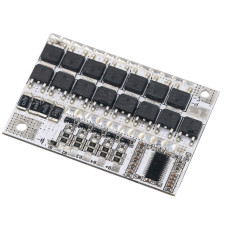
The BMS module 3S (4S, 5S) 100A Li-ion, Li-po 3.7V has a balancing function and controls the process of uniform charging/discharging and protection for each series-connected battery in a set of 3S Li-ion, Li-po format 18650, 26650 or others with a similar charging voltage up to 4.2 V.
The board of the protective BMS controller 3S 100A Li-ion, Li-po has two connection scheme options that affect the operating mode, namely the maximum current of 60 A. If the "-" of the load and the charger are connected to the common contact pad "C-", then the maximum operating current will be 60 A. If the "-" load is connected to "P-" and the "-" of the charger to "C-", then the maximum operating current will be 100 A.
BMS protection module with balancer on 3S Li-ion, Li-po has the ability to reconfigure operation for a different number of battery cells to 3 or 5 by installing or removing jumpers near the contact pads "B1" and "B2" and under the microcircuit.
The jumper order is as follows:
for 3S: jumpers near "B1", "B2" and under the microcircuit: the left side should be "slow", the right side is a jumper (by default)
for 4S: jumpers near "B1" and under the microcircuit: the left side should be a jumper, the right side is "permissible"
for 5S: without two jumpers under the microcircuit and under "B1" and "B2"
The BMS protection module board with a balancer has LEDs for each battery cell, the LED lights up when the cell is balanced during operation or charging, but goes out in fully charged batteries when charging is complete.
The board provides a temperature control interface by connecting a 10 kΩ NTC thermistor. For this, there are corresponding contact pads marked NTC on the back of the module. In this case, the overheating protection will be triggered in the 60 °C zone.
Reducing the protection current and load is possible by removing one or more shunt resistors "R003", each soldered resistor reduces the current by 25%.
These 3S 100A (QSKJ) module boards are well suited for converting power tools to power from lithium batteries.
Self-recovery after overload occurs by switching the load or short-term connection of "C-" and "B-".
There are versions of this module for Li-ion and LiFePO4 batteries. For Li-Ion batteries, BMS based on the BM3451 TNDC-T28A controller (BM3451TNDC-T28A) is used, and for Li-ion, Li-po batteries, BMS based on the BM3451 BHDC-T28A (BM3451BHDC-T28A).
Technical characteristics of the BMS module 3S (4S, 5S) 100 Li-ion, Li-po 3.7V:
Controller: BM3451 TNDC-T28A (BM3451TNDC-T28A SOP-28)
Number of battery cells: 3S, 4S, 5S (3S by default)
Battery type: Li-ion, Li-po 3.7 V
Cell balancing: yes
Cell balancing current: 50 mA
Protection function:
overcharge (4.25 V)
overdischarge (2.8 V)
short circuit
overcurrent overload (60 A/100 A)
optional battery overheating (temperature control interface)
Protection response time:
overcharge: 1.5...2.5 s
overdischarge: 0.5…1.5 s
Overall dimensions (L×W×H): 61×42×4 mm
Assignment of contact pads of the BMS module 3S (4S, 5S) 100 A Li-ion, Li-po 3.7V:
B-: "minus" of the first cell
B+: "plus" of the last cell, load, charger
B1: "plus" of the first cell and "minus" of the second cell (jumper to ground for 3S and 4S mode)
B2: "plus" of the second cell and "minus" of the third cell (jumper to ground for 3S mode)
B3: "plus" of the third cell and "minus" of the fourth cell
B4: "plus" of the fourth cell and "minus" of the fifth cell
P-: "minus" of the load for 100 A mode
C-: "minus" of the charger or load and charger for 60 A mode
NTC: connection of a 10 kOhm NTC thermistor
Note:
Use batteries of the same type, preferably of the same batch and year of manufacture
Before installing the battery, balance them using

There are no reviews for this product, be the first to leave your review.